How to make a wedding guest list (and track RSVPs, meals and seating without the chaos)
Build a wedding guest list that fits your venue: A and B lists, plus-ones, RSVPs, meal counts for the caterer and a seating plan, step by step.
The guest list touches almost everything else in a wedding. It decides the size of venue you need, what the caterer charges, how many invitations you print and how many tables you set. It's also the part most likely to cause a family argument.
The good news: a guest list is just a list. If you keep it in one place, with the right columns from the start, it stays manageable from the first draft to the seating chart.
Step 1: Start with your limit, not your names
Before you write a single name, know the number you're working to. It's usually the smaller of two things: how many people your venue holds, and how many people your budget can feed.
If your budget allows $9,600 for food and your caterer charges $80 a head, that's $9,600 ÷ $80 = 120 guests. If your favourite venue seats 110, your real limit is 110.
Step 2: Build the A list and the B list
Write down everyone you might invite, then sort them into two groups:
- A list: the people you can't imagine the day without. Immediate family, the wedding party, close friends.
- B list: people you'd love to have if there's room. Colleagues, friends you see less often, the extra cousins.
If the A list is already over your limit, cut it now, before anyone has heard they're invited. A simple test helps: have you seen them, or spoken to them properly, in the last couple of years? Would you both be comfortable sitting at a table together?
Count plus-ones and children as guests from the start. A "Smith family" line that turns out to be five people is how lists quietly grow.
Step 3: Send the A list, then fill seats from the B list
Invite the A list first, with a clear RSVP deadline. As replies come in, you'll see how many seats are open. Here's how that might look for a venue that holds 120:
| A list | Guests |
|---|---|
| Invited | 112 |
| Attending | 90 |
| Declined | 14 |
| No reply yet | 8 |
Attending, declined and no reply add back up to the 112 invited. To be safe, count the 8 without a reply as coming. That's 90 + 8 = 98 seats spoken for, leaving 120 − 98 = 22 open. You might send B list invitations to 15 or 20 people rather than all 22, so a few late yeses from the A list don't put you over.
Send B list invitations early enough that they don't feel like a last-minute afterthought, and give them the same RSVP deadline style as everyone else.
Step 4: Track RSVPs in one place
For each guest, keep a short row of columns. The ones that actually get used:
- Side and group: whose guest they are, and whether they're family, friends, work.
- Save the date and invitation: sent or not, so nobody gets missed.
- RSVP: yes, no or waiting.
- Plus-one: whether they have one, and their name once you know it.
- Meal and allergies: the caterer will need both.
- Table: for the seating plan.
- Address: for invitations now and thank-you cards later.
The day after the RSVP deadline, filter for everyone still waiting and follow up by text or phone. It's normal to chase a handful of people.
Step 5: Give the caterer clean meal counts
If you're offering a choice of meals, your caterer will want final numbers by a set date. Count only confirmed guests, plus-ones included. For 96 confirmed guests it might look like this:
| Meal | Guests |
|---|---|
| Beef | 40 |
| Chicken | 34 |
| Vegetarian | 18 |
| Kids | 4 |
| Total | 96 |
Allergies go separately, by name, so the kitchen knows which plate goes where. A meal count that doesn't match your confirmed guest count is a sign someone's row is missing a choice.
Step 6: Seat everyone
Do the seating plan last, once RSVPs are in. With 96 guests and tables of 8, you need 96 ÷ 8 = 12 tables. Start with the easy groups (immediate family, the wedding party's partners, a group of university friends), then fit in the people who don't know many others next to someone friendly. Keep couples and plus-ones together, and put older relatives away from the speakers.
Assign each guest a table on the guest list itself, rather than in a separate drawing. Then a change in one place doesn't leave two versions that disagree.
After the wedding
The same list does one more job: thank-you cards. Add what each guest gave and tick off each card as it goes in the mail. You already have their addresses.
A guest list that does the counting for you
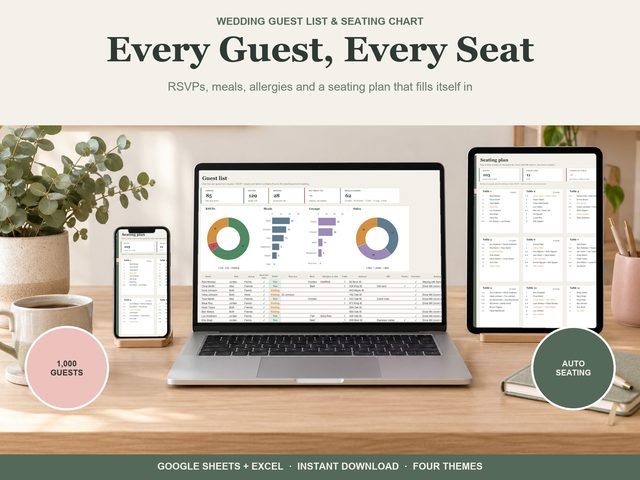
Our Wedding Guest List template keeps all of this in one spreadsheet. The guest list holds up to 1,000 guests with side, group, save the date, invitation, RSVP, plus-one, meal, allergies, table, address, where they're staying, gift and thank-you, with charts for RSVPs, meals, groups and sides. Type a table number and the seating plan fills itself in: 20 tables, with seat numbers and plus-ones, and guests still waiting on their RSVP shown in orange. It also has a gifts and thank-yous list and a contacts sheet for the wedding party and family. It works in Google Sheets (free) and Excel 365.
To sort out the money side, see our wedding budget breakdown.