Wedding budget breakdown by category: how to split your total (with a $25,000 example)
A simple way to split a wedding budget by category, a worked $25,000 example, a deposit and payment schedule, and where wedding budgets usually leak.
Most couples start with one number: what they can spend in total. The hard part is turning that one number into a plan for the venue, the photographer, the flowers and the dozens of small things in between.
The easiest way to do it is to start from a common split, put your own numbers in, and then adjust it to what matters to you. A split is a starting point, not a rule. If photos are the thing you'll keep forever, give photography more and take it from somewhere you care less about.
Start with the big three decisions
Before you split anything, settle three things, because they drive almost every other cost:
- Your total. Include everyone's contribution: your savings, anything parents have offered, and money you're expecting from gifts only if it's actually promised.
- Your guest count. Food, drinks, chairs, tables, invitations and favours all scale with it.
- Your must-haves. Pick two or three things you'd spend more on, and one or two you're happy to keep simple.
A common split, worked for $25,000
Here's one way to divide a $25,000 total. Venue, food and drinks usually take the biggest share, so they're grouped together here. The percentages add up to 100, and the dollar amounts add up to exactly $25,000.
| Category | Share | Amount |
|---|---|---|
| Venue, food and drinks | 45% | $11,250 |
| Photography and video | 12% | $3,000 |
| Attire, hair and makeup | 8% | $2,000 |
| Flowers and decor | 8% | $2,000 |
| Music and entertainment | 7% | $1,750 |
| Rings | 3% | $750 |
| Stationery | 2% | $500 |
| Officiant and licence | 2% | $500 |
| Transport | 2% | $500 |
| Favours and gifts | 2% | $500 |
| Buffer for surprises | 9% | $2,250 |
| Total | 100% | $25,000 |
Two things to notice. First, the buffer. Keeping a slice unassigned is what stops one surprise from wrecking the whole plan. If you never need it, it's money for the honeymoon or your first month of married life.
Second, the table is coarse on purpose. Once you start getting quotes, split the big lines further: venue, catering, bar and cake each deserve their own line, because they're often different vendors with different deposits.
Adjusting the split
Say you want a photographer whose package is $4,000, not $3,000. That extra $1,000 has to come from somewhere. You might:
- Trim flowers and decor from $2,000 to $1,500 by reusing ceremony flowers at the reception.
- Trim music from $1,750 to $1,250 with a DJ instead of a band.
That's $500 + $500 = $1,000 moved, and the total still sits at $25,000. This is the whole game: every time one line goes up, decide right then which line comes down.
Deposits and the payment schedule
A wedding isn't paid all at once. Most vendors take a deposit or retainer to hold your date, then one or more payments before the day. Terms vary a lot by vendor, so read each contract, but here's an example of how three bookings might look:
| Vendor | Total | At booking | 6 months before | 1 month before | 2 weeks before |
|---|---|---|---|---|---|
| Venue and catering | $11,250 | $2,500 | $4,000 | $4,750 | |
| Photographer | $3,000 | $1,000 | $2,000 | ||
| Florist | $2,000 | $500 | $1,500 | ||
| Due | $16,250 | $4,000 | $4,000 | $2,000 | $6,250 |
Look at the bottom row. Those three vendors alone ask for $6,250 in the last two weeks. That's the moment many couples feel squeezed, because final balances, alterations and last-minute purchases all land together. Knowing it's coming months ahead means you can set money aside for it.
Also check which deposits are refundable. Many aren't, so a deposit is money spent, not money held.
Where wedding budgets usually leak
Big line items rarely surprise anyone. It's the edges that add up.
- Guest count creep. If your caterer charges $100 a head, adding 20 guests adds $2,000 to food alone, before drinks, chairs and invitations. Agree on the guest list before you book the venue.
- Service charges and tax. Venue and catering quotes are often shown before a service charge and sales tax. Ask for the all-in number before you compare.
- Alterations and accessories. The dress or suit price is rarely the final price once fitting, shoes and accessories are added.
- Delivery, setup and overtime. Rentals, flowers and cake may charge to deliver and set up, and photographers and DJs may charge for extra hours if the day runs long.
- Vendor meals. Your photographer and DJ usually need to eat, and that may be on your bill.
- The small stuff. Postage, signage, the guest book, a hotel room to get ready in. No one item is big, but a dozen of them can eat a good part of your buffer.
Track planned, booked and paid separately
The most useful habit is keeping three numbers for every category: what you planned, what you've booked (the signed contract price), and what you've actually paid. Planned vs booked tells you if you're over budget. Booked vs paid tells you what you still owe, and when.
A spreadsheet that does this for you
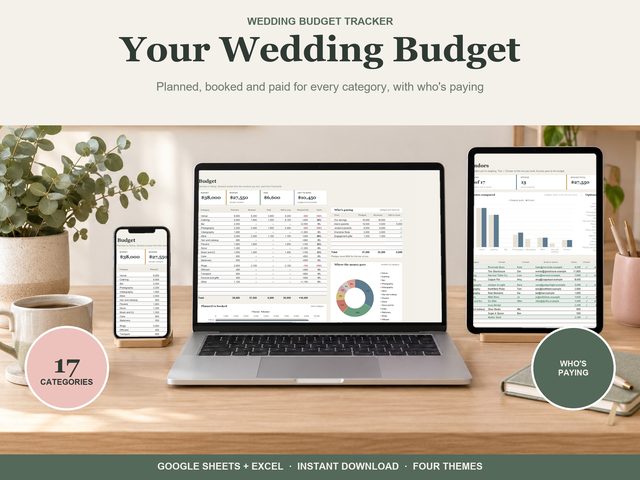
Our Wedding Budget Tracker is built around exactly this. It has 17 categories, each with planned, booked, paid, still to pay and what's left. You can track who's paying (parents, savings, gifts) with what's been pledged and what's been received. On the Vendors tab you compare quotes, packages and ratings, then tick the one you book and its price goes straight to the budget. The Payments tab lists deposits and balances with due dates, with anything overdue in red, and there's a separate honeymoon budget too. It works in Google Sheets (free) and Excel 365.
Planning more than the money? See how to plan a wedding in one spreadsheet.