How to price handmade products: find your true cost, then pick a formula that pays you
Work out what one handmade item really costs, compare five pricing formulas, and see a fully worked candle example with fees and profit.
Most makers price by looking at what everyone else charges and going a little lower. The trouble is that other sellers don't pay your supplier, don't work at your speed, and may not be making any money either. A price that works starts with one number only you know: what one item really costs you.
Step 1: find your true cost per item
Your true cost has four parts. Leave one out and every sale quietly loses money.
- Materials: everything that ends up in or on the item, at what you actually paid for it.
- Labour: your minutes to make one item, times the hourly rate you want to earn. Your time is a cost, even if nobody sends you a paycheque.
- Packaging: box, tissue, sticker, thank-you card.
- Overhead: a fair share of everything else: tools, software, rent or studio space, the electricity for your melter.
Selling fees come on top. Marketplace fees, payment processing and listing fees are usually a percentage of the price plus a small fixed amount, so they grow as the price grows. Fees change, so check the current rates for wherever you sell rather than trusting an old blog post (including this one).
Step 2: pick a pricing formula
There's no single right formula. These five cover what most makers use, and comparing them side by side is the fastest way to see where your price should land.
- Cost × 2 × 2. The classic maker's rule: true cost × 2 gives a wholesale price, and wholesale × 2 gives retail. It leaves room to sell to shops later without losing money.
- Target margin. Decide what share of the price you want to keep, then divide: price = cost ÷ (1 − margin). For a 60% margin, price = cost ÷ 0.4.
- Markup. Add a percentage on top of cost: price = cost × (1 + markup). A 150% markup means cost × 2.5.
- Cover the fees. Start from cost plus the profit you want (say 30% on top of cost), then gross it up so the fees are paid too: price = (cost × 1.3 + fixed fee) ÷ (1 − fee percentage).
- Your price now. Whatever you charge today, run through the same maths so you can see what it really leaves you.
Margin and markup get mixed up constantly. A 150% markup and a 60% margin give the same price: on a $10 cost, markup gives $25, and $15 profit is 60% of $25. Same number, two ways of describing it.
A worked example: one candle
Here's a 250 ml soy candle in a glass jar with a lid.
| Cost | Amount |
|---|---|
| Soy wax | $2.40 |
| Fragrance oil | $1.80 |
| Wick | $0.20 |
| Jar and lid | $2.60 |
| Label | $0.25 |
| Materials | $7.25 |
| Labour: 12 minutes at $22 an hour | $4.40 |
| Packaging | $1.10 |
| Overhead | $0.75 |
| True cost per candle | $13.50 |
Labour is 12 ÷ 60 × $22 = $4.40. Add it all up and the candle costs $13.50 before a single fee.
For the fees, this example uses 8% of the price plus $0.30 per sale. That's an illustration, not any platform's real rate: put in the current fees for where you sell.
Now the five methods, with this candle's numbers:
| Method | Price | Fees | Profit | True margin | Per hour |
|---|---|---|---|---|---|
| 1. Cost × 2 × 2 | $54.00 | $4.62 | $35.88 | 66% | $201 |
| 2. Target margin (60%) | $33.75 | $3.00 | $17.25 | 51% | $108 |
| 3. Markup (150%) | $33.75 | $3.00 | $17.25 | 51% | $108 |
| 4. Cover the fees | $19.40 | $1.85 | $4.05 | 21% | $42 |
| 5. Your price now | $24.00 | $2.22 | $8.28 | 35% | $63 |
How each line works:
- Fees = price × 8% + $0.30. At $33.75 that's $2.70 + $0.30 = $3.00.
- Profit = price − fees − true cost. At $33.75: $33.75 − $3.00 − $13.50 = $17.25.
- True margin = profit ÷ price. $17.25 ÷ $33.75 = 51%.
- Per hour = (profit + the labour you already counted) ÷ hours spent. At $33.75: ($17.25 + $4.40) ÷ 0.2 hours = $108.25 an hour.
- Cover the fees: ($13.50 × 1.3 + $0.30) ÷ (1 − 0.08) = $17.85 ÷ 0.92 = $19.40. Profit is $4.05, which is the 30% on cost it was built to keep.
Notice that the 60% target margin ends up as a 51% true margin. The formula aims for 60% of the price, but fees come out of that afterwards. That gap is why it's worth checking every price after fees.
Reading the result
The $24 price feels fine at the market table, but it leaves $8.28 per candle. The $54 price may be more than buyers will pay for a candle this size. Somewhere around $32 to $36 covers every cost, pays you for your time, and leaves real profit, so that's the range to compare against similar candles and test.
A few habits that help:
- Re-run your costs when supplier prices change. A jump in jar prices quietly eats your margin.
- Don't forget shipping. If you offer free shipping, the label is a cost; add it to packaging or build it into the price.
- Watch your per-hour number. If it's below what you'd accept at a job, the price is too low or the making takes too long.
- Raise prices on the products that sell best first. Demand there is proven.
If you also want to know where your profit goes once the sales roll in, our guide to bookkeeping for Etsy sellers covers what to record each month.
Do the maths in a spreadsheet
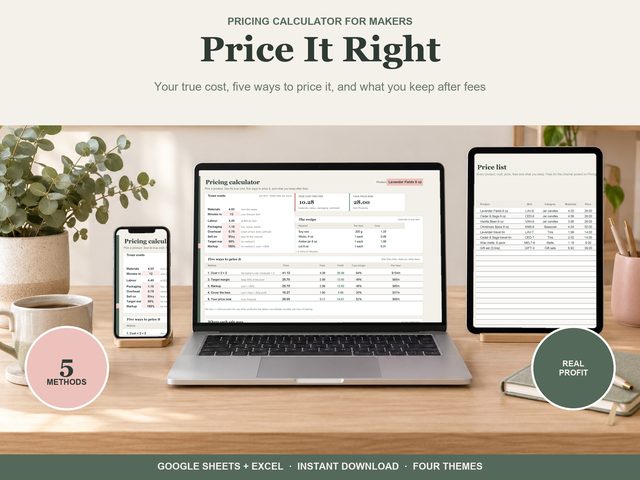
Our Pricing Calculator does this for every product. Pick one and it pulls the material cost from its recipe, adds your time, packaging and overhead, and shows all five ways to price it, each with the fees for where you sell, your profit, margin and what you earn per hour. A chart shows where each sale goes, and the price list flags any product priced too low. Works in Google Sheets and Excel.