Bookkeeping for Etsy sellers: a simple system you'll actually keep up with
What to record, which categories to use, how to handle receipts, and a 20-minute monthly routine that makes year-end easy for Etsy sellers and makers.
Bookkeeping sounds like a job for an accountant, but for a small Etsy shop or maker business it comes down to one habit: write down every dollar that comes in and every dollar that goes out, with a category, close to when it happens. Do that and tax time becomes a matter of adding things up.
This is a general guide, not tax advice. Your accountant, the CRA or the IRS have the final word for your situation.
What to record
For every transaction, you want the same handful of details:
- Date
- Amount, with any sales tax in its own column
- Category (more on these below)
- Who it was with: the customer, supplier or platform
- Account it went through: bank, credit card, PayPal, cash
- Receipt: do you have one saved, yes or no
That last one matters more than it looks. When you go looking for a receipt at year-end, a simple tick tells you which ones are missing while you still have time to find them.
Record gross sales, not just your deposits
This is the most common mistake Etsy sellers make. Etsy takes its fees out before it pays you, so your bank deposit is smaller than your actual sales. If you only record deposits, your income looks lower and you lose track of your fees, which are a business expense.
Record the full sale amount as income and the fees as an expense. Your Etsy payment account and monthly statements show both.
Categories that keep things simple
You don't need dozens. Most makers get by with something like this:
- Income: Etsy sales, market and in-person sales, wholesale, website sales, shipping charged to buyers
- Materials and supplies: everything that goes into what you make
- Selling fees: marketplace, listing, payment processing
- Shipping and postage: labels you buy
- Packaging: boxes, mailers, tissue, stickers
- Advertising: paid ads, market booth fees, business cards
- Software and subscriptions: design tools, apps, your website
- Equipment: tools and machines (bigger items may be handled differently at tax time; ask your accountant)
- Vehicle: business trips, logged as you go
- Home office: the business share of your space, worked out at year-end
The best categories line up with the lines on your tax form: the T2125 in Canada or Schedule C in the US. Then year-end is just moving totals across.
A worked month
Here's one month for a small candle shop:
| Category | In | Out |
|---|---|---|
| Etsy sales (gross) | $1,240.00 | |
| Market sales | $380.00 | |
| Materials | $412.50 | |
| Selling fees | $168.30 | |
| Shipping labels | $96.40 | |
| Packaging | $54.20 | |
| Software | $29.00 | |
| Market booth | $45.00 | |
| Total | $1,620.00 | $805.40 |
Profit for the month: $1,620.00 − $805.40 = $814.60.
Notice the Etsy line. If this seller had only recorded the deposit, they'd have written down $1,240.00 − $168.30 = $1,071.70, and their $168.30 of fees would have vanished from their expenses. Same profit on paper, but a messier record, and nothing to show at year-end for where that money went.
Receipts
Keep a receipt for every expense. A photo on your phone is fine for most purposes, as long as it's readable. Two habits make this painless:
- Snap the receipt the moment you pay, before it goes in a pocket.
- Save digital receipts into one folder, named with the date and vendor.
The CRA generally expects you to keep records for six years, and the IRS asks for at least three years in most cases. Check the current rules for your situation, and keep them longer if in doubt.
Recurring costs and mileage
Subscriptions, insurance and studio rent are easy to forget because nobody hands you a receipt each month. List them once with how often they come out, and count them on their dates.
Driving to the post office, the craft store or a market counts as business travel. Log the date, where you went, why and the distance. The deduction is worked out from those trips at a per-kilometre or per-mile rate that changes, so check the current CRA or IRS rate rather than guessing.
Sales tax
If you're registered for GST/HST in Canada or collect sales tax in a US state, track the tax you collect and the tax you pay separately from your sales and expenses. For Canadian Etsy sellers, whether Etsy collects GST/HST for you depends on whether you're registered: our GST/HST guide for Etsy sellers walks through it.
The 20-minute monthly routine
Once a month, sit down with your statements and:
- Download your Etsy monthly statement and record gross sales and fees.
- Go through your bank and card statements and enter anything you missed.
- Tick off receipts and chase the missing ones.
- Check your recurring costs came out as expected.
- Look at profit for the month and compare it with the same month last year.
- If you file sales tax, note what you owe for the period and when it's due.
Year-end
If you've kept up monthly, year-end is short:
- Total each category and match it to its T2125 or Schedule C line.
- Total your business mileage.
- Work out your home office share if you use one.
- Set aside money for income tax on your profit. A rough share of each month's profit set aside as you go makes this far less painful.
- Send it all to your accountant, or use it to file yourself.
Knowing your profit per month also tells you whether your prices are working. If they aren't, our guide on how to price handmade products shows how to work out what to charge.
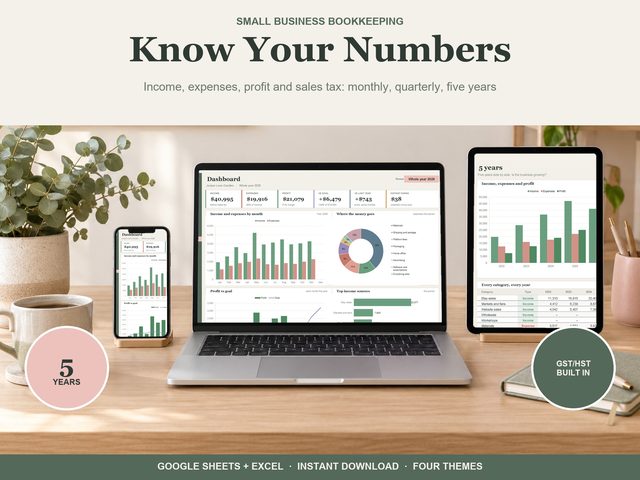
A spreadsheet that adds it up for you
Our Small Business Bookkeeping template is built for this routine, for Canada and the US. Type each transaction once, with sales tax in its own column and a receipt tick, and the dashboard shows income, expenses and profit for the year, a quarter or a month, against your goal and the same months last year. It has tabs for recurring costs and mileage in km or miles, sales tax owing for each filing period with due dates, and a year-end page with every category on its T2125 and Schedule C line and what to set aside. Works in Google Sheets and Excel.