GST/HST for Etsy sellers in Canada: what you actually owe
If you sell on Etsy from Canada, GST/HST is confusing for one reason: Etsy collects some of it for you, and some of it may still be yours to handle. Here's how the pieces fit.
This is a plain-language summary, not tax advice. Rules change; check the CRA's pages or an accountant for your own situation.
Do you need to register at all?
Most new sellers don't have to. You're a small supplier while your taxable sales, across all your businesses, stay at $30,000 or less over any four calendar quarters in a row. Small suppliers don't have to register for GST/HST or charge it.
Once you go over $30,000 you have to register, and soon: if you pass it within a single quarter, you start charging GST/HST on the sale that took you over.
You can register before then. The main reason to do it is that a registered business can claim back the GST/HST it pays on business expenses (input tax credits). The cost is that you then have to file returns.
What Etsy does, and doesn't
Since July 2022, Etsy collects GST/HST on some Canadian orders. Which ones depends on whether you are registered (Etsy's help page):
- Not registered (no GST/HST number on your Etsy account): on physical items shipped from you in Canada to a buyer in Canada, Etsy charges the buyer GST/HST at checkout and sends it in. You don't.
- Registered (your number is on Etsy): Etsy does not collect GST/HST on your physical goods. You charge it, usually by building it into your prices, and you send it in with your own return.
- Provincial sales tax: Etsy also collects PST in some provinces. Check what your Etsy tax reports show before you count it.
So once you register, your Etsy sales to Canadian buyers count in what you owe, just like your other sales. Digital downloads have their own rules; check Etsy's page and the CRA's for your case.
Sales Etsy never sees
If you're registered, you also charge GST/HST on sales outside Etsy:
- your own website or Shopify store,
- markets, craft fairs and in-person sales,
- wholesale orders to shops.
The rate depends on where the buyer is: 5% GST in Alberta and the territories, 5% GST plus provincial sales tax rules in BC, Saskatchewan, Manitoba and Quebec, and HST (13% to 15%) in Ontario and the Atlantic provinces.
Tracking it without a headache
For each filing period (monthly, quarterly or yearly, set by the CRA when you register) you need three numbers:
- Collected: GST/HST you charged on your own sales.
- Paid: GST/HST you paid on business purchases: your input tax credits.
- Owing: collected minus paid. If it's negative, you get a refund.
The simplest habit: type every sale and expense with its tax in its own column, the day it happens. Then the totals per period add themselves up.
Year-end: the T2125
Sole proprietors report business income on the T2125 (Statement of Business or Professional Activities) with their personal return. Each expense goes on a line: advertising, supplies, fees, vehicle, business-use-of-home and so on. If you track categories all year, filling it in takes minutes.
Do it in one spreadsheet
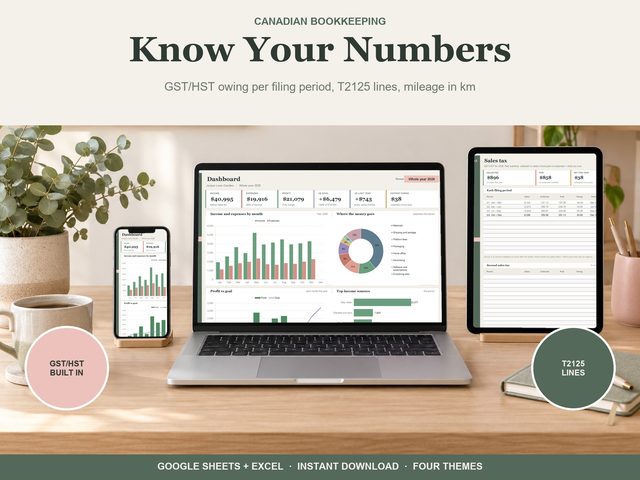
Our Canadian Bookkeeping template has GST/HST collected, paid and owing for each filing period with due dates, a second tax table for PST or QST, every category on its T2125 line, and mileage in kilometres. Type each sale and expense once; the rest fills in.
 Canadian Bookkeeping