Emergency fund vs sinking funds: what's the difference, and why you need both
One is for costs you can't predict, the other for costs you can. A worked year shows what happens to an emergency fund without sinking funds beside it.
An emergency fund and a sinking fund are both just money in a savings account. So it's fair to ask why you'd bother keeping them apart.
The short answer: they protect you from different things, and when you mix them, the predictable bills quietly eat the money that was meant for the unpredictable ones.
The difference in one line each
- Emergency fund: money for costs you can't see coming. You don't know if, when or how much.
- Sinking funds: money for costs you can see coming. You know roughly what and when, you just pay for them in one lump.
What an emergency fund is for
- Losing your job, or your hours being cut
- Being too sick or injured to work for a while
- A major repair you couldn't have planned for: the furnace, a burst pipe, a transmission
- An urgent trip for a family emergency
- Insurance deductibles when something goes badly wrong
The common guideline is three to six months of essential expenses: what you'd need to keep the lights on, not your full lifestyle. If your essentials are $3,000 a month, that's $9,000 to $18,000. People with less steady income, like freelancers or anyone on commission, often aim for the top of that range or beyond.
That's a big number, so most people build it in stages. A small starter amount first, even one month of essentials, already turns a lot of emergencies into inconveniences.
What sinking funds are for
- Car insurance, registration, tires and routine repairs
- Christmas, birthdays and other gifts
- Annual subscriptions and memberships
- Vacations
- Back-to-school, sports fees
- Property tax, if it isn't paid through your mortgage
None of these are emergencies. They're on the calendar, or close enough. Each one gets a target, a date and a monthly amount. If you haven't set them up before, our guide to sinking funds walks through which ones to start and how to work out the monthly amount.
The grey zone
Some costs could go either way. Car repairs are the classic one: an oil change and a new set of tires are predictable, so they belong in a sinking fund. A blown engine is not, so that's the emergency fund.
A simple test: if it happens most years, it's a sinking fund. If it would genuinely surprise you, it's an emergency.
A year without sinking funds
Here's what happens when one savings account does both jobs. Someone has a $4,000 emergency fund and no sinking funds. Over the year, four bills come in:
| Bill | Amount | Emergency fund left (no sinking funds) | Emergency fund left (with sinking funds) |
|---|---|---|---|
| Starting balance | $4,000 | $4,000 | |
| Car insurance renewal | $1,440 | $2,560 | $4,000 |
| Christmas | $900 | $1,660 | $4,000 |
| New tires | $800 | $860 | $4,000 |
| Furnace repair | $2,000 | −$1,140 | $2,000 |
Without sinking funds, three ordinary, predictable bills drain the emergency fund down to $860. When a real emergency arrives, the furnace, there isn't enough, and $1,140 lands on a credit card.
With sinking funds, the insurance, Christmas and tires come out of their own pots. The emergency fund is untouched until the furnace, and still has $2,000 left afterwards.
Covering those three predictable bills ($1,440 + $900 + $800 = $3,140) would have taken about $262 a month in sinking funds ($3,140 ÷ 12 = $261.67). That's the whole difference between a credit card balance and a cushion that's still there.
And without an emergency fund?
The opposite problem. If all you have is sinking funds, the first real emergency gets paid by raiding them: the vacation fund covers the furnace, then Christmas goes on a card. The plan you built falls apart because it had nothing behind it.
That's why you need both. Sinking funds keep the predictable stuff from touching your emergency fund, and the emergency fund keeps the unpredictable stuff from wrecking your sinking funds.
Which first?
If you're starting from nothing, a reasonable order is:
- A starter emergency fund, enough to cover a surprise repair without a credit card.
- Sinking funds for the next few known bills, especially anything due in the next six months.
- Grow both together, splitting what you can save each month between them until the emergency fund reaches three to six months of essentials.
If you have high-interest debt, paying it down belongs in that mix too. The debt snowball vs avalanche post covers how to tackle it.
Where to keep them
Keep the emergency fund somewhere separate from your everyday chequing account, easy to reach in a day or two but not on your debit card. A high-interest savings account is a common choice. Sinking funds can share one account as long as you track how much belongs to each.
This is a general explanation, not personal financial advice. What's right for you depends on your income, your job and your obligations.
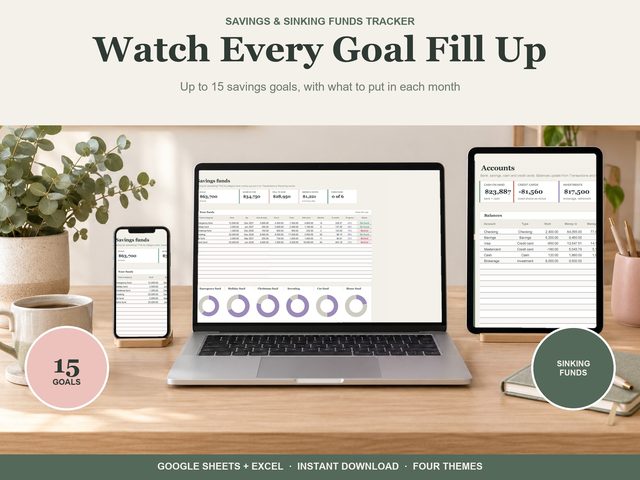
See both at a glance
Our Savings Tracker holds up to 15 savings goals, so your emergency fund and every sinking fund can each have their own. Each goal gets a progress ring, the amount saved so far, an on-track or behind check, and how much to put in each month to reach it by your date. Deposits go in once on Recurring (every payday, monthly and so on) or on Transactions and count toward their goal by themselves, and your bank, savings, cash and investment balances stay up to date on the Accounts tab. Works in Google Sheets (free) and Excel 365.