Debt snowball vs avalanche: which one pays off faster?
There are two popular ways to pay off several debts at once. Both start the same way: pay the minimum on everything, then put every extra dollar on one debt until it's gone, and roll that payment into the next.
The only difference is which debt goes first.
- Snowball: the smallest balance first. You clear whole debts sooner, and each one gone feels like progress.
- Avalanche: the highest interest rate first. Mathematically, this always costs the least interest.
The same debts, paid both ways
Here's a real example. Four debts, $550 a month in minimum payments, plus an extra $200 a month: $750 in total, every month, until everything is paid.
| Debt | Balance | Interest | Minimum |
|---|---|---|---|
| Store card | $1,200 | 29.99% | $40 |
| Credit card | $6,500 | 19.99% | $160 |
| Line of credit | $3,500 | 10.5% | $90 |
| Car loan | $9,800 | 7.9% | $260 |
| Debt-free in | Total interest | |
|---|---|---|
| Snowball (smallest first) | 34 months | $4,023 |
| Avalanche (highest rate first) | 33 months | $3,689 |
| Same $550, no extra $200 | 52 months | $7,252 |
The avalanche wins by one month and $334. The extra $200 a month matters far more than the method: it saves about $3,200 and a year and a half either way.
So which should you pick?
- Pick the avalanche if your highest-rate debt is also big, and you trust yourself to keep going without quick wins. The bigger the gap between your rates, the more it saves.
- Pick the snowball if you've started a payoff plan before and stopped. Clearing a whole debt in the first few months is a real reason people keep going, and a plan you finish beats a plan that's optimal on paper.
- Or mix them: knock out one or two tiny balances first for the quick win, then switch to the highest rate.
Whichever you choose, the two things that matter most are the same: pay a fixed amount every month, and when a debt is gone, move its whole payment to the next one instead of spending it.
Try it with your own numbers
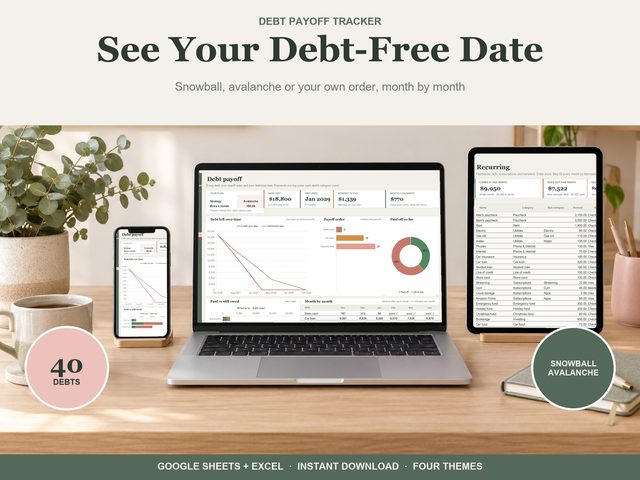
Our Debt Payoff Tracker does this math for you. List your debts once, pick snowball, avalanche or your own order, add an extra payment, and it shows the month each debt is paid off, your debt-free date and the total interest, with snowball, avalanche and minimums-only compared side by side.
The example compounds interest monthly at the stated annual rate. Real card interest is usually charged daily, so your numbers will be slightly different.
 Debt Payoff Tracker