Sinking funds: what they are, which to set up, and how much to save each month
Sinking funds turn big once-a-year bills into small monthly ones. Which funds to start, and the simple sum for the monthly amount, with a worked table.
Some of the biggest bills of the year aren't surprises at all. Car insurance renews on the same date every year. Christmas is in December every year. Tires wear out. And yet these are exactly the bills that blow up a budget, because they show up all at once in a month that was already full.
A sinking fund fixes that. It's money you set aside a little at a time for a cost you know is coming, so when the bill arrives, the money is already sitting there.
How a sinking fund works
Take a known cost, divide it by the months until it's due, and save that amount every month.
Car insurance is $1,440 a year, paid once at renewal. Save $120 a month for 12 months and the renewal is just a transfer, not a crisis.
The money can sit in one savings account for all your funds, or in separate accounts if your bank makes that easy. What matters is that you know how much of the balance belongs to each fund.
Which sinking funds to set up
Start with the costs that caught you off guard last year. Common ones:
- Car: insurance if you pay it yearly, registration, repairs, tires, oil changes
- Home: property tax if it's not in your mortgage, repairs, appliances
- Holidays and gifts: Christmas, birthdays, weddings you're invited to
- Annual subscriptions and memberships: software, warehouse club, roadside assistance
- Pets: vet visits, vaccinations, grooming
- Kids: back-to-school, sports fees, camps
- Travel: the summer trip, flights home for the holidays
- Medical and dental: glasses, anything your plan doesn't cover
Don't start fifteen at once. Three to five covering your biggest predictable costs is plenty to begin with. Add more as those settle in.
The sum for the monthly amount
Monthly amount = (target − already saved) ÷ months left
That's it. If you already have some money put aside, subtract it first. If the date is close, the monthly amount goes up; if it's far away, it goes down.
A worked example
Here's a household setting up seven funds. Some are starting from zero, a couple already have a head start.
| Fund | Target | Saved so far | Months left | Monthly |
|---|---|---|---|---|
| Car insurance | $1,440 | $0 | 12 | $120 |
| Christmas | $900 | $300 | 8 | $75 |
| Car repairs and tires | $1,200 | $0 | 12 | $100 |
| Summer vacation | $2,400 | $600 | 8 | $225 |
| Annual subscriptions | $240 | $0 | 12 | $20 |
| Vet | $600 | $0 | 12 | $50 |
| Back to school | $360 | $0 | 6 | $60 |
| Total | $7,140 | $900 | $650 |
Working two of them through:
- Christmas: $900 − $300 = $600 still to save, over 8 months: $600 ÷ 8 = $75 a month.
- Vacation: $2,400 − $600 = $1,800 still to save, over 8 months: $1,800 ÷ 8 = $225 a month.
$650 a month across seven funds feels like a lot until you compare it with the alternative: $6,240 of bills still to come ($7,140 minus the $900 already saved), landing in a handful of months, most likely on a credit card.
If you're paid every two weeks
Multiply the monthly total by 12 and divide by 26 paydays: $650 × 12 = $7,800 a year, and $7,800 ÷ 26 = $300 a paycheque. Set that up as an automatic transfer on payday and the funds build themselves. (More on matching monthly costs to biweekly pay in how to budget around biweekly paychecks.)
Two kinds of sinking funds
- Goal funds have a date and an end: Christmas, a vacation, back to school. Once you've paid the bill, the fund starts over for next time.
- Rolling funds never really finish: car repairs, home repairs, the vet. You keep paying in, take money out when something comes up, and the balance goes up and down.
For rolling funds, look at what you spent in that category over the last year or two, divide by 12, and save that. If the fund keeps growing past what you ever need, lower the monthly amount.
Sinking funds aren't your emergency fund
A sinking fund is for costs you can see coming. An emergency fund is for the ones you can't: a job loss, an injury, the furnace dying in January. You need both, and keeping them apart is what stops Christmas from eating the money meant for a real emergency. We go through it in emergency fund vs sinking funds.
This is a general explanation of a savings method, not personal financial advice.
Track every fund in one place
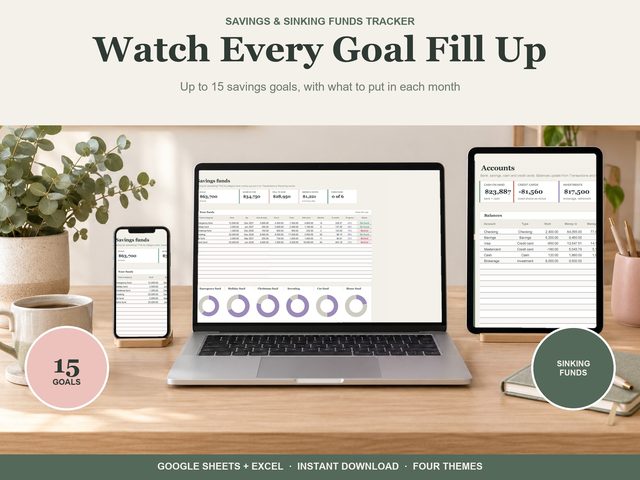
Our Savings Tracker handles up to 15 savings goals. For each one it shows a progress ring, how much you've saved so far, whether you're on track or behind, and how much to put in each month to make your date. Deposits go in once on Recurring (every payday, monthly and so on) or on Transactions, and count toward their goal by themselves. It also keeps your bank, savings, cash and investment balances up to date. Works in Google Sheets (free) and Excel 365.
If you'd rather run sinking funds inside a full budget, the Paycheck Budget includes up to 15 sinking funds too, alongside a safe-to-spend number for every pay period.