The 50/30/20 rule in practice: what really goes in needs, wants and savings
How the 50/30/20 budget works on a real $5,200 take-home pay, what counts as a need, a want or savings, and when to bend the split.
The 50/30/20 rule is the simplest budget there is. Take your after-tax income and split it three ways:
- 50% to needs: the things you have to pay to live and work.
- 30% to wants: the things that make life better but could stop tomorrow.
- 20% to savings and debt: your future self, plus paying down what you owe beyond the minimums.
It was popularized by Elizabeth Warren and Amelia Warren Tyagi in their book All Your Worth. The appeal is that you only track three numbers, not thirty categories.
The hard part is deciding what goes where. Here's how to sort it, then a worked example.
What counts as a need
A need is something you'd still have to pay if you lost your job tomorrow and cut everything back.
- Rent or mortgage, property tax, home or tenant insurance
- Utilities, a basic phone plan and internet
- Groceries (not takeout)
- Getting to work: car payment, insurance, gas, transit pass
- Childcare, prescriptions, basic clothing
- Minimum payments on debts
The trap is the upgraded need. Groceries are a need; a $40 grocery delivery fee is a want. A phone is a need; the newest phone on a monthly plan is partly a want. Put the basic version in needs and the upgrade in wants.
What counts as a want
Everything you choose rather than have to: eating out, streaming, hobbies, gym memberships, travel, new clothes beyond the basics, gifts, the nicer version of a need.
Wants aren't bad. Thirty percent is a big slice on purpose: a budget with no room to enjoy anything is one you'll abandon.
What counts as savings
- Emergency fund
- Retirement: RRSP or TFSA in Canada, a 401(k) or IRA in the US
- Saving for a goal like a down payment
- Extra debt payments above the minimum
One thing people miss: if your workplace takes pension or retirement contributions off your pay before it lands, that money is already being saved. You can count it toward your 20%, as long as you add it back to your income figure so the percentages stay honest.
A worked example on $5,200 take-home
Say one person brings home $5,200 a month after tax. The textbook split:
| Bucket | Share | Amount |
|---|---|---|
| Needs | 50% | $2,600 |
| Wants | 30% | $1,560 |
| Savings and debt | 20% | $1,040 |
| Total | 100% | $5,200 |
Now their real needs:
| Need | Monthly |
|---|---|
| Rent | $1,700 |
| Groceries | $600 |
| Utilities and internet | $250 |
| Car insurance and gas | $350 |
| Minimum debt payments | $150 |
| Phone | $70 |
| Total needs | $3,120 |
$3,120 is 60% of $5,200, not 50%. Rent alone is a third of their take-home pay. That's not unusual in a lot of cities, and it doesn't mean the budget has failed. It means the split needs to bend.
Bending it: 60/20/20
The fix here is to keep savings at 20% and take the extra 10% out of wants:
| Bucket | Share | Amount |
|---|---|---|
| Needs | 60% | $3,120 |
| Wants | 20% | $1,040 |
| Savings and debt | 20% | $1,040 |
| Total | 100% | $5,200 |
Here's how that $1,040 of wants could look:
| Want | Monthly |
|---|---|
| Eating out | $300 |
| Streaming and apps | $60 |
| Hobbies and going out | $300 |
| Clothes | $150 |
| Haircuts and personal care | $80 |
| Travel (set aside monthly) | $150 |
| Total wants | $1,040 |
And the $1,040 of savings: $400 to the emergency fund, $340 to retirement, and $300 extra on a credit card. $400 + $340 + $300 = $1,040.
Still a real life with eating out and a trip, still saving a fifth of their pay.
When to bend the rule
The percentages are a starting point, not a law. Some good reasons to change them:
- High housing costs. Like the example: 60/20/20 is a common, honest adjustment. Protect the savings slice before the wants slice.
- High-interest debt. If you're carrying a credit card at 20% or more, a temporary 50/20/30 (20% wants, 30% savings and debt) clears it much faster. See debt snowball vs avalanche for which debt to hit first.
- No emergency fund yet. Push savings higher for a few months until you have a cushion.
- A big goal with a date. A wedding or down payment might justify 50/20/30 for a year.
- Your needs are well under 50%. Don't inflate wants to fill the gap. Send the difference to savings.
What matters is that you choose the split on purpose and check it each month, instead of finding out at year-end where the money went.
The one thing the rule doesn't do
50/30/20 tells you how much goes to wants, but not which wants. If you find the three buckets too loose, try giving every dollar a specific job instead: that's zero-based budgeting, and the two work well together.
This is a general explanation of a budgeting rule of thumb, not personal financial advice.
Check your split automatically
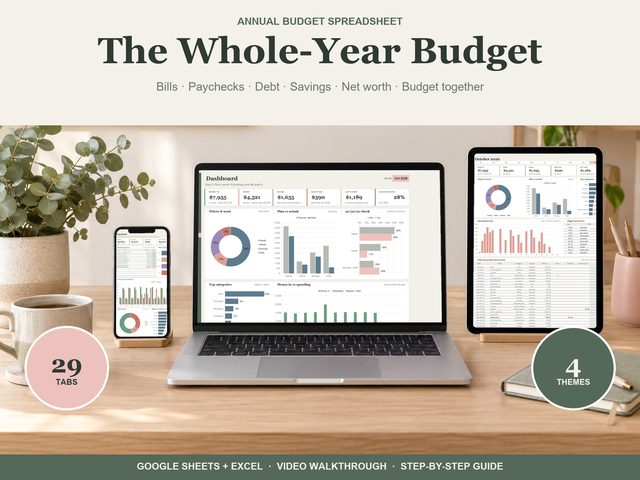
Our Annual Budget spreadsheet puts every category in a group (Needs, Wants, Savings or Debt), so the 50/30/20 check on the dashboard works itself out from what you really spend, for any month. The aims start at 50/30/20 and you can change them on Setup if 60/20/20 fits your life better. Add purchases on Transactions, enter paycheques and bills once on Recurring, and the month tabs, bill calendar and dashboard fill themselves in. Google Sheets (free) and Excel 365.