Inventory tracking for makers: materials, recipes and reorder points that stop you running out
Track raw materials and finished goods separately, cost every product with a recipe, and set reorder points. A worked soap-making example.
Running out of one ingredient halfway through a batch is the classic maker's inventory problem. The other one is quieter: not knowing what a product really costs because supply prices crept up. Both are fixed by the same simple system: track materials and finished products separately, and connect them with a recipe.
Raw materials vs finished goods
A maker has two kinds of stock, and they need tracking differently.
- Raw materials are what you buy: wax, yarn, beads, fabric, oils, boxes. You track them in their own units (grams, millilitres, metres, each) and at what you paid.
- Finished goods are what you sell: the candles, scarves and soaps on your shelf. You track how many you made, how many sold, and how many are left.
A reseller only has finished goods. A maker turns one into the other, which is where most spreadsheets fall apart. The bridge is the recipe.
Recipes (a bill of materials)
A recipe, or bill of materials, lists exactly what goes into one finished item. It does two jobs at once:
- It costs the product. Multiply each material's quantity by its cost per unit and add them up.
- It tells you what a batch uses. Make 24 and you've used 24 times the recipe.
To get a cost per unit, divide what you paid by how much you got. If prices change between orders, use the average cost across your purchases so one cheap or expensive order doesn't throw everything off.
A worked example: a bar of soap
Here's what a small soap maker bought, and the cost per unit of each:
| Material | Bought | Paid | Cost per unit |
|---|---|---|---|
| Olive oil | 4,000 ml | $36.00 | $0.009 per ml |
| Coconut oil | 2,000 g | $18.00 | $0.009 per g |
| Lye | 1,000 g | $12.00 | $0.012 per g |
| Essential oil | 100 ml | $15.00 | $0.15 per ml |
| Kraft box | 50 | $20.00 | $0.40 each |
And the recipe for one bar:
| Material | Per bar | Cost |
|---|---|---|
| Olive oil | 60 ml | $0.54 |
| Coconut oil | 40 g | $0.36 |
| Lye | 14 g | $0.17 |
| Essential oil | 3 ml | $0.45 |
| Kraft box | 1 | $0.40 |
| Materials per bar | $1.92 |
Lye works out to 14 × $0.012 = $0.168, so the bar's total is $1.918, or $1.92. That's materials only: your time, packaging extras and overhead come on top when you set the price (our guide on how to price handmade products covers that part).
Making a batch
Now the maker pours a batch of 24 bars. The recipe says what that uses, and what's left:
| Material | Had | Batch of 24 uses | Left |
|---|---|---|---|
| Olive oil | 4,000 ml | 1,440 ml | 2,560 ml |
| Coconut oil | 2,000 g | 960 g | 1,040 g |
| Lye | 1,000 g | 336 g | 664 g |
| Essential oil | 100 ml | 72 ml | 28 ml |
| Kraft box | 50 | 24 | 26 |
Finished goods go up by 24 bars. Materials go down by exactly what the recipe says. Logging each batch this way keeps both counts honest without a full stocktake every week.
Reorder points
A reorder point is the level at which you order more, so the new supply arrives before you run out. A simple version:
Reorder point = what you use per week × weeks the supplier takes to deliver + a safety buffer
Say this maker sells about 12 bars a week. Using a one-week buffer:
| Material | Used per week | Delivery time | Reorder at | Left | Status |
|---|---|---|---|---|---|
| Olive oil | 720 ml | 1 week | 1,440 ml | 2,560 ml | OK |
| Coconut oil | 480 g | 1 week | 960 g | 1,040 g | OK, close |
| Lye | 168 g | 1 week | 336 g | 664 g | OK |
| Essential oil | 36 ml | 1 week | 72 ml | 28 ml | Reorder |
| Kraft box | 12 | 2 weeks | 36 | 26 | Reorder |
Weekly use is 12 bars × the recipe: 12 × 60 ml = 720 ml of olive oil, for example. Reorder at is weekly use × (delivery weeks + 1 buffer week): for boxes, 12 × 3 = 36.
The essential oil is the surprise. It's a small amount per bar, but the bottle is small too: 28 ml is only enough for 9 more bars. Without a reorder point, the next batch would have stopped partway.
Finished goods: watch them too
Keep an eye on finished stock the same way. If 15 of the 24 bars sell in the first week, 9 are left and next week's batch needs to go in soon. Your best sellers deserve a low-stock warning of their own.
A quick checklist:
- Count materials in the units you use them in, not the units you buy them in.
- Update costs every time you restock, so your recipes stay accurate.
- Log every batch, even small test ones.
- Do a real count every few months to catch spills, breakage and mistakes.
- Raise reorder points before busy seasons.
Let a spreadsheet do the counting
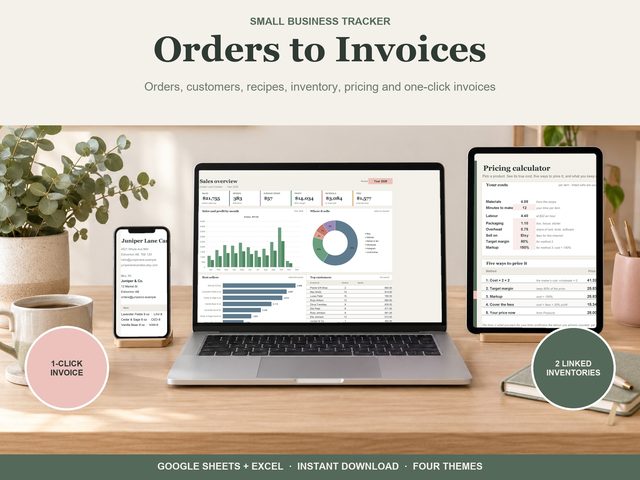
Our Small Business Tracker is built around this flow. Log restocks and it keeps each material's average cost, stock on hand, stock value and reorder alerts. Recipes cost every product from your restock prices; the make log adds finished products and uses up materials with each batch. Products shows finished stock made, sold and on hand, with low or out in colour. It also tracks orders, customers and invoices, includes a pricing calculator and price list, and works in Google Sheets and Excel.