Annual vs monthly budget: why you need both (and how to combine them)
A monthly budget runs your day to day; an annual budget catches the bills that only come once a year. Here's how to use them together, with real numbers.
Most people budget month by month. Money comes in, bills go out, you see what's left. It works fine, right up until a month with car repairs, an insurance renewal or the holidays, and suddenly the budget "doesn't work".
It worked. It just couldn't see far enough ahead. That's what an annual budget is for.
What a monthly budget does well
A monthly budget is about cash flow. It answers: will the money coming in this month cover what's going out?
- It matches how you're paid and how most bills arrive.
- It keeps everyday spending like groceries and gas in check.
- It's short enough to actually track. You can look at one month and see where things went.
Its weak spot is anything that doesn't happen every month.
The costs a monthly budget misses
Irregular costs are the expenses you know are coming, just not every month. They're not emergencies. They're predictable, and that's exactly why they're frustrating when they catch you out.
- Car maintenance, tires and repairs
- Insurance paid once or twice a year
- Vehicle licence and registration
- Gifts, birthdays and the holidays
- Annual subscriptions and memberships
- Back-to-school costs and kids' activities
- Clothing and shoes
- A vacation
Each of these is "not this month" in a monthly budget. Then one month, several land at once.
What the year view adds
An annual budget lays out all twelve months side by side. Instead of asking "what do I spend this month?", it asks "what do I spend in a year, and when?"
That view does two things a monthly budget can't:
- It shows the real total. Add up the irregular costs and they're often bigger than people expect.
- It shows the heavy months. December, back-to-school and insurance renewal months stand out before they arrive.
How to combine them: the monthly set-aside
The trick is simple. Add up your irregular costs for the year, divide by 12, and treat that number as a monthly bill you pay to yourself. Each set-aside goes into its own savings pot, often called a sinking fund, and when the cost arrives, you pay it from there.
Here's a worked example:
| Irregular cost | Per year | Per month |
|---|---|---|
| Vacation | $2,400 | $200 |
| Gifts and holidays | $1,500 | $125 |
| Car maintenance | $1,200 | $100 |
| Clothing | $900 | $75 |
| Home insurance | $600 | $50 |
| Annual subscriptions | $240 | $20 |
| Vehicle registration | $120 | $10 |
| Total | $6,960 | $580 |
That's $580 a month. Without the year view, this household would have a "budget" that looks $580 better than it really is, and then a few months a year that blow it apart.
A worked monthly budget with the set-aside built in
Now drop that $580 into a normal monthly budget. Say the household brings home $5,200 a month:
| Category | Per month |
|---|---|
| Housing | $1,900 |
| Groceries | $800 |
| Transportation | $450 |
| Utilities | $250 |
| Phone and internet | $150 |
| Everything else | $300 |
| Irregular costs set-aside | $580 |
| Savings | $770 |
| Total | $5,200 |
Every dollar has a job, and the irregular costs are already paid for, a little at a time. When December arrives, the gifts money is sitting there. When the car needs tires, the maintenance pot covers it.
A few months in, a pot may run low because a cost came early. That's fine: move money from another pot or from savings, and adjust the monthly amount if it keeps happening. A quiet month doesn't mean you can spend that month's set-aside. It rolls over, waiting for the month it's needed.
Which one should you use?
Both. They do different jobs.
- The annual budget is the plan. Make it once, then check it a few times a year or when something big changes, like a new job, a move or a new car.
- The monthly budget is where you live. Track it as you go and compare plan to actual at the end of each month.
If you're paid every two weeks, the year view also shows your two "extra" paycheque months. Our post on budgeting around biweekly paycheques covers what to do with them.
The numbers here are an example, not advice for your situation. Use your own statements to fill in your costs.
Do both in one spreadsheet
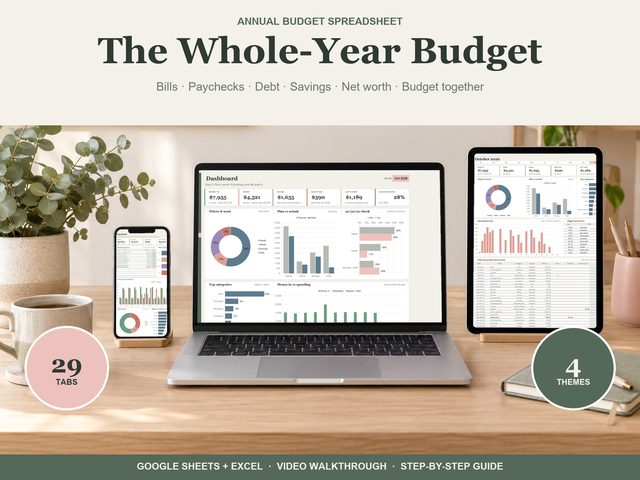
Our Annual Budget spreadsheet for Google Sheets and Excel puts the year view and the month view together. Enter paychecks, bills and subscriptions once on Recurring, add purchases on Transactions, and the 12 month tabs, dashboard and bill calendar fill themselves in.
For irregular costs, the zero-based plan works month by month with roll-over, and Savings funds tracks up to 15 goals with progress rings, so each sinking fund has its own pot. Year at a glance shows every category across all twelve months, the paycheck planner shows what's due before your next payday, and there's debt payoff, net worth and budgeting together for up to 6 people when you need them.